
Organized Intelligences
Love, Mentorship, and Presence in the Age of AI
“Now the Lord had shown unto me, Abraham, the intelligences that were organized before the world was; and among all these there were many of the noble and great ones.”[i]
“And he beheld the spirits that God had created, and he beheld also things which were not visible to the natural eye; and from thenceforth came the saying abroad in the land: A seer hath the Lord raised up unto his people.”[ii]
We all have everyday seers in our life who can peer deeply into our souls. They go beyond answering the surface-level questions we are asking and inspire us with deeper questions that we should be asking.
These are the mentors in our life who change us the most. They don’t just see our trajectory and envision our future. They see us. They see our countenance. They see our joy and our pain. They see our strengths, weaknesses, and motives. And they can see it all because they love us.
Mentors
Chris Culver, AHS Art Teacher (left) and Laurie Swim, AHS Trustee (right). The vision and experience of loving mentors is one of the most valuable sources of inspiration in life.
A “Pandemic of Isolation and Loneliness”
Elder Gerrit W. Gong
Elder Gerrit W. Gong speaks about discipleship in an age of artificial intelligence at a recent conference, November 5, 2025 (image credit Spencer Yamada/Faith Matters). In his remarks, Elder Gong acknowledged that “AI is opening new and remarkable opportunities to lift and bless” and also could further worsen a “pandemic of isolation and loneliness.”
We live in an age of instant gratification and ubiquitous answers to almost any question. It’s a “brave new world” of artificial intelligence and the “AI companion.”[iii] As of late 2025, the two most frequent uses of artificial intelligence are (1) productivity and knowledge work (writing and editing, research and summary, coding and debugging, brainstorming ideas, etc.); and (2) companionship and emotional support (“relational AI” such as interactive online companions and counselors).[iv]
Ironically, it is also an age of what Elder Gerrit Gong, whose own father pioneered AI systems, recently described as a “pandemic of isolation and loneliness.”[v]
Last year, our AHS Safety Committee was deliberating about next steps in promoting mental and emotional health in our school community. One of the ideas presented was an AI-powered emotional support companion developed by a K–12-focused software company. The promise of the developers was that the AI companion would meet students anytime, anywhere, even at 3 a.m. when no human being would be available to counsel an anxious or depressed teenager. Moreover, the AI was trained on a closed universe of safe content, carefully vetted by a board of professional K-12 school psychologists, and programmed to nudge the teen toward a human therapist at every turn. It would also cost a fraction of school counselors. The pitch was compelling.
Dr. Alicia Henderson, a wise and experienced member of our AHS student counseling office, spent some time test-driving and interacting with the AI companion. She concluded the following:
Strengths – The AI companion gives really great tips for students struggling or feeling overwhelmed with academics. It also gives sound suggestions, such as with making friends and sleeping. It validates often; I don’t know how I feel about AI validating me when it has not lived the breadth and depth of human emotions that life offers us.
Weaknesses – The AI companion seems unable to engage in true motivational interviewing, which is so key to change or initiating effective behavior. It did start asking about values, which was good.
And then she added these feelings, which I will never forget:
My last two cents… I’m so deeply concerned that as a society we are turning to Google for help, instead of reaching out to our wise elderly neighbor across the street, who can offer perspective and a reminder that we can tolerate uncertainty and loss. I’m concerned that when we want a recipe for peach cobbler we ask an AI companion, instead of our friend or grandma who has a stellar recipe. I’m concerned that youth are asking the internet for help, instead of catching a leader while they are mowing the lawn or making fresh pasta and pulling up a chair or porch step to chat. It is in those moments we find out how people are really doing. There is no vulnerability with AI, and therefore no courage exercised. No relationships strengthened. No burdens lifted. No connections made. We lose so much of the valuable substance of society when we forget to turn to people.[vi]
Sydney Kopp and Holly Robinson
Sydney Kopp, AHS Student Council President, with AHS teacher, coach, and mentor Holly Robinson. “The older I grow, the more I am convinced that there is no education which one can get from books and costly apparatus that is equal to that which can be gotten from contact with great men and women.” (Booker T. Washington)
To be clear, none of this is to say that AI systems are useless or inherently dangerous. “The fact that technology can be misused, does not mean that it should never be used,” said Elder Gong.[vii] Indeed, Elder Kim Clark, the former commissioner of Church Education, has recently proposed that a proprietary AI companion be developed specifically for Church Education System students, trained on Church resources only, and used under very specific and carefully controlled circumstances.[viii]
But we must also keep in mind the following:
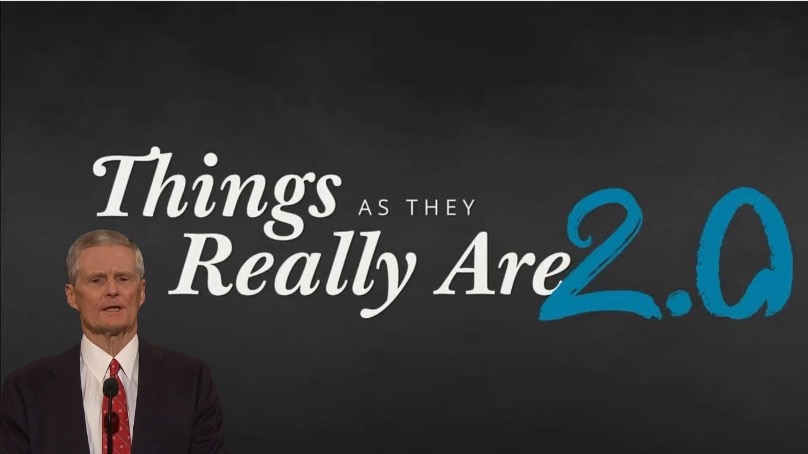
“Always remember that an AI companion is only a mathematical algorithm. It does not like you. It does not care about you. It does not really know if you exist or not. To repeat, it is a set of computer equations that will treat you as an object to be acted upon, if you let it. Please, do not let this technology entice you to become an object… My intent is not to suggest that artificial intelligence is inherently bad; it is not… But the righteous possibilities of this amazing technological tool can be realized only if we are aware of and guard against its perils.”[ix]
LDS Perspectives on Artificial Intelligence
Recently I attended a conference devoted to Latter-day Saint perspectives on artificial intelligence. The conference was held at the Church Office Building in downtown Salt Lake City. Presenters included faithful Latter-day Saints who are experts in their fields of science, technology, law, education, psychology, government, human development, child protection, and a host of other fields that have been pulled into the swirling vortex of AI.
Most presenters conveyed a sense of gratitude for AI and the myriad ways that it is already benefiting society, balanced by warnings of the dangers of AI if developed and used irresponsibly.
All agreed that AI is so uniquely transformational in the history of technology advancements that it is less like a new internet application and more like a humanity-altering breakthrough akin to the internet itself, electricity, and even fire.
It was a fascinating experience to hear so many presenters, from so many different fields, grapple with fundamental questions like:
- “What is intelligence?”
- “What makes for authentic relationships between humans?”
- “How does AI change the relationships that human beings have with each other?”
- “What makes humans intelligent?”
- “Is it possible for a machine to have an authentic relationship with a human being?”
- “If AI is a ‘large language model,’ then what is language, and why is it important to humans?”
- “Intelligence is moral, relational, and capable of love.”[x]
- “Humanity’s existence is only fulfilled when in relationship with the Divine.[xi]
- “Human-to-human and human-to-divine relationships are lacking in AI systems.”[xii]
- “Covenantal relationships are grounded in a relationship with God the Father and his son Jesus Christ.”[xiii]
- “I see AI as a remarkable flow of divinely inspired technologies that enable learning to flourish both secularly and spiritually. I believe that Father in Heaven has allowed for AI to come forth, and that the Lord is preparing wonderful opportunities for us to experience “deep learning,” which also comes with significant challenges. The foundation of deep learning is Jesus Christ. He is the way, the truth, and the light of the world. Because of Him, the Holy Ghost can teach us all truth. Only through Him is deep learning possible.”[xiv]
- AI architecture begins with intent. What exactly are we building AI for? If we say “efficiency” we get speed. If we say “profit” we get systems that exploit. If we say to make human beings healthier, more moral, more thriving, then we get those outcomes. Unpurposed intelligence is dangerous. Purposed intelligence is productive.[xv]
- Trust is part of the beauty of any architecture. We don’t see the beams in the high-rise, but we know that they’re there, and we trust them. Like any architecture, trust in an AI system’s architecture is built through three blueprints: (1) transparency (walls should be glass where they can be; so should AI systems); (2) testimony (systems that can bear witness to their reasoning; why they answered as they did; what evidence they relied on; honesty and integrity; so should AI systems); and (3) testing (systems need to be continuously measured and tested to maintain trust and accountability; so should AI systems).[xvi]
I was particularly moved by the thoughts of Dr. Terryl Givens, who entitled his remarks “Human Intelligence: Love, Language, and Presence.”[xvii]
Dr. Terryl Givens
Senior research fellow at the Neal A. Maxwell Institute of Religious Scholarship at Brigham Young University. Until 2019, he was a professor of literature and religion at the University of Richmond, where he held the James A. Bostwick Chair in English.
Nothing is more sacred than for one human to enter into a sacred relationship with another human being. Relationships have two pre-requisites: (1) boundedness, and (2) a way across that boundedness.
Love is the conquest of distance. We calibrate love by the distance that parties have crossed to forge it.
Jesus invited us to become neighbors with those who we view as separated by some distance or difference. Christianity places a premium on embodiment. Incarnation is God’s living witness that the most complete version of the divine is the enfleshed form of divinity. Presence becomes the bridge across the chasm. The boundedness of our body is the precondition of the love and relationships that we construct.
We should really ask not “When will AI simulate human intelligence?” but rather “When did human intelligence begin to emulate AI?” The task of the humanities is to challenge and refine the most moral and edifying hierarchies of human attention. We show preference for certain ways of knowing over other ways of knowing.
Many who claim to know Christ never knew Christ. Did we know Him only through our left brain, mathematically, or did we know Him through the right brain also, present with Him, feeling Him? [xviii]
On Love, Mentorship, and Presence
The 2024 documentary film entitled Music by John Williams chronicles the life and work of composer John Williams, one of the greatest modern musicians of our time. Williams composed and orchestrated the movie scores for many of the most epic films in the last half century, including Star Wars, Superman, Indiana Jones, E.T., Jurassic Park, Harry Potter, Close Encounters, Fiddler on the Roof, and more.
Steven Spielberg and John Williams
Filmmaker Steven Spielberg (left) with composer John Williams (right). Their friendship and mentorship of each other spanned decades and continues even today. Spielberg is 79 and Williams is 93; both are still working… together.
Music by John Williams
The 2024 documentary film entitled “Music by John Williams” chronicles the life and work of composer John Williams, one of the greatest musicians of our time. It also demonstrates the power and influence of personal mentorship.
What struck me most about Williams’ arc of success was his mentorship and friendship with the American filmmaker Steven Spielberg. Williams and Spielberg were inseparable, creating an astounding 30 films together. Both credited their success to each other, and it is difficult to say which of the two had the greater influence on the other.
One thing is clear, they deeply loved and respected each other, they mentored each other, and their respective gifts were magnified in the presence of each other.
History abounds with examples of gifted individuals whose talents were magnified or channeled in the presence of inspiring friendship and mentorship: Socrates and Plato (philosophy); Emerson and Thoreau (literature); Ray Charles and Quincy Jones (music); Warren Buffet and Bill Gates (business and philanthropy); George Mason and Thomas Jefferson; Abraham Lincoln and William Seward (government); the Beecher and Stowe families’ religious and political influence on Harriet Beecher-Stowe (American Civil War abolitionism); Susan Anthony and Elizabeth Stanton (women’s civil rights); J.R.R. Tolkien and C.S. Lewis (religion and religiously influenced literature); and Ziauddin Yousafszai and his daughter, Malala (international women’s rights), to name a few.[xix]
Sometimes it takes losing our mentors before we fully realize how much influence they had upon us, how much we loved them, how much they refined us, and how much we relied upon them for our strength and success.
In the case of John Williams, it wasn’t just Spielberg who inspired greatness in him. Williams and his wife Barbara were lifetime friends and partners. She was a Hollywood actress; he was a Hollywood composer. They had a loving and committed marriage that produced three children. In 1974, Barbara died suddenly from a cerebral hemorrhage in her early 40’s, leaving behind John and the children.
John described Barbara’s passing as one of the most difficult and painful chapters in his life, but also a defining moment in his creative journey. He said that after Barbara’s death, her presence actually became more influential in his music, describing “a feeling that she was actually by his side.”[xx]
“I felt like she was helping me,” he said. “I still have the feeling today. In some way I grew up artistically [after her death], or gained some kind of energy, or it penetrated what I was doing more deeply. And the busiest, most successful period in my life in film started immediately thereafter, when I was asked to do a film called Star Wars.”[xxi]
And thus his music took on another dimension, inspired by the presence of what he described as a loving mentor from another dimension.
John Williams and Barbara
Composer John Williams with his first wife, Barbara. After her passing, John felt he “gained some kind of energy” from her, that “penetrated more deeply his work,” that she was “by his side” helping him as he composed music.
Booker T. Washington at Tuskegee Institute, 1903
Booker T. Washington (front row center, third from left), seated next to Andrew Carnegie (on Washington’s left) and other sponsors, faculty, and distinguished graduates of the Tuskegee Institute, later Tuskegee University, Alabama, 1903.
Natural intelligence requires more than IQ or information. Natural intelligence is capable of authentic relationships, and ultimately authentic love. In turn, authentic relationships and authentic love require presence with other people, or in the language of scripture, “organized intelligences.”
In the end maybe Booker T. Washington said it best:
“The older I grow, the more I am convinced that there is no education which one can get from books and costly apparatus that is equal to that which can be gotten from contact with great men and women.”
With gratitude for every act of love and mentorship, seen and unseen, that is the lifeblood of our school community,
Grant Beckwith
Head of School
Thanks So Much For Reading!
A QUICK NOTE:
Hi! My name is Sister Mya Holyoak and I am one of the service missionaries who helps out at American Heritage Worldwide Studios. I loved being able to rework this incredible article written by Mr. Beckwith to be featured on our blog. Thanks again for reading! Please leave a like or comment if you have any questions or thoughts about this topic. We’d love to hear from you!
Let’s stay in touch. Here are three great ways to reach us:
- Schedule a consultation for current virtual school families here.
- Email us at familyschool@ahsworldwide.org
- Send us a chat from 9:00 AM – 2:00 PM from Family School or the chat button on our website.
Sources
[i] Abraham 3:22
[ii] Moses 6:36
[iii] Salman Khan, founder of Khan Academy, published his 2024 book Brave New Words: How AI Will Revolutionize Education (and Why That’s a Good Thing), which touts the benefits of AI tutors for students and also promotes Khanmigo, his new AI tutoring software business.
[iv] Marc Zao-Sanders, “How People Are Really Using Gen AI in 2025,” Harvard Business Review, Apr. 9, 2025, https://hbr.org/2025/04/how-people-are-really-using-gen-ai-in-2025 See also, National Association of Independent Schools, 2025 Trends.
[v] Elder Gerrit W. Gong, “Discipleship in an Age of Artificial Intelligence,” presented at “Organized Intelligence: LDS Perspectives on AI” conference, Nov. 17–18, 2025. “We have a pandemic of isolation and loneliness,” he said. “It started prior to the Covid pandemic. Overuse of SM and AI can leave us disconnected from human relationships. Many of us are on devices from the time we wake up to the time we go to sleep. Precisely because AI can distort core covenantal relationships, our topic is timely.” See Deseret News summary of Elder Gong’s and other presenters’ remarks: https://www.deseret.com/faith/2025/11/05/church-of-jesus-christ-wont-use-ai-to-create-images-of-jesus-or-conference-talks/ Elder Gong was also tasked with overseeing the Church’s committee to outline principles of responsible AI use, which are published here: https://www.churchofjesuschrist.org/learn/artificial-intelligence?lang=eng
[vi] Dr. Alicia Henderson, PhD, Clinical Psychologist.
[vii] Elder Gerrit W. Gong, “Discipleship in an Age of Artificial Intelligence,” Id.
[viii] Elder Kim B. Clark, “Deep Learning in the Age of AI,” presented at “Organized Intelligence: LDS Perspectives on AI” conference, Nov. 17–18, 2025. Elder Clark did not say that such an AI companion was under development, only that he had a vision of its potential usefulness under very carefully controlled circumstances. See Elder Clark’s presentation at https://www.youtube.com/watch?v=7mgeZASyErM and a Church News summary: https://www.thechurchnews.com/living-faith/2025/11/10/elder-kim-clark-ensign-college-devotional-ai-artificial-intelligence-education/
[ix] Elder David A. Bednar “Things As They Really Are 2.0,” Nov. 23, 2024, Worldwide Devotional for Young Adults, https://www.churchofjesuschrist.org/study/broadcasts/worldwide-devotional-for-young-adults/2024/11/13bednar?lang=eng and https://www.youtube.com/watch?v=9AblogGUK2k
[x] Dr. Medlir Mema, BYU-Idaho
[xi] Id.
[xii] Id.
[xiii] Id.
[xiv] Elder Kim Clark, Id. “Deep Learning in the Age of AI”
[xv] Bennett Bordon, “The Moral Architecture of Intelligence” presented at “Organized Intelligence: LDS Perspectives on AI” conference, Nov. 17–18, 2025.
[xvi] Id.
[xvii] Credit to Dr. Givens and to Dr. Medlir Mema, the Organized Intelligence conference organizer, for their influence on the title of this article.
[xviii] Dr. Terryl Givens, “Human Intelligence: Love, Language, and Presence,” presented at “Organized Intelligence: LDS Perspectives on AI,” conference, Nov. 17–18, 2025.
[xix] Sometimes the mentor or partner is a kind of “equal opposite” who offers occasional opposing but complimentary views, like John Adams and Thomas Jefferson; Abraham Lincoln and William Seward; Joseph Smith and Brigham Young; and Susan Anthony and Elizabeth Stanton.
[xx] “Music by John Williams,” 2024 documentary film, George Lucas Films (Disney).
[xxi] Id.